JUVAPORT

Impacts of harbour redevelopment on fish recruitment, metamorphosis and juvenile quality

Project at a glance

2022-2028

Port-Vendres (FR)

Diplodus vulgaris

Marine ecology

Ecophysiology

Endocrinology

Ecological compensation

Context

Shallow coastal habitats are essential nursery grounds for many marine fishes. After several weeks developing in the open sea, fish larvae return to coastal environments, settle into suitable nursery habitats and undergo metamorphosis into juveniles. During this critical period, the availability and quality of nursery habitats can strongly influence juvenile survival and ultimately the renewal of adult populations.
Coastal urbanisation is, however, profoundly modifying these habitats. The redevelopment of the commercial harbor of Port-Vendres provides a particularly relevant case study. The construction of a new container wharf required the infilling of an entire small cove that previously supported a fish nursery, thereby replacing a natural shallow-water habitat with port infrastructure. At the same time, ecological compensation measures, including artificial fish nursery structures installed beneath the new wharf, aim to partly restore the nursery functions lost during development.
JUVAPORT takes advantage of this major transformation to investigate how the construction of new harbor infrastructure affects fish recruitment and juvenile development before, during and after construction.

Objectives

From abundance to nursery quality

Monitoring the number of juvenile fishes provides essential information on the use of harbor habitats, but abundance alone does not necessarily indicate that a habitat functions as a high-quality nursery. JUVAPORT therefore combines population-level monitoring with measurements of individual fish phenotype and physiological condition. Our collaborators at CEFREM monitor juvenile fish populations and nursery use throughout Port-Vendres harbor, while the EcoEvoDevo team at BIOM regularly samples newly recruited Diplodus vulgaris throughout their recruitment season. By combining these complementary scales, the project asks not only how many juveniles use these habitats, but also how well these individuals are developing.

Key questions

1. How does harbour redevelopment affect fish recruitment?

JUVAPORT follows larval and juvenile fish abundance and distribution in Port-Vendres before, during and after the construction of the new wharf. This long-term approach allows us to investigate how the loss and transformation of nursery habitats affect recruitment dynamics and how young fishes redistribute across the remaining and newly created habitats within the harbor.
FicheTerrainResmed

2. Does harbour redevelopment affect juvenile phenotype and condition?

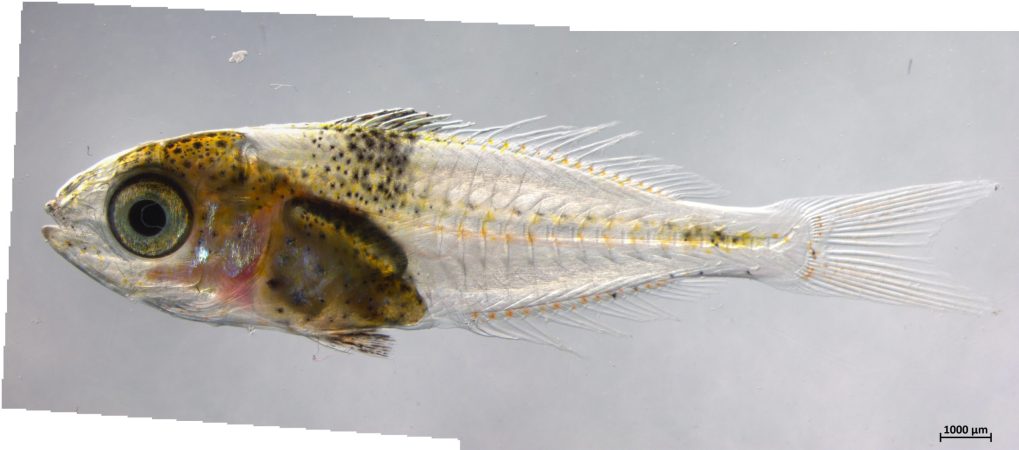
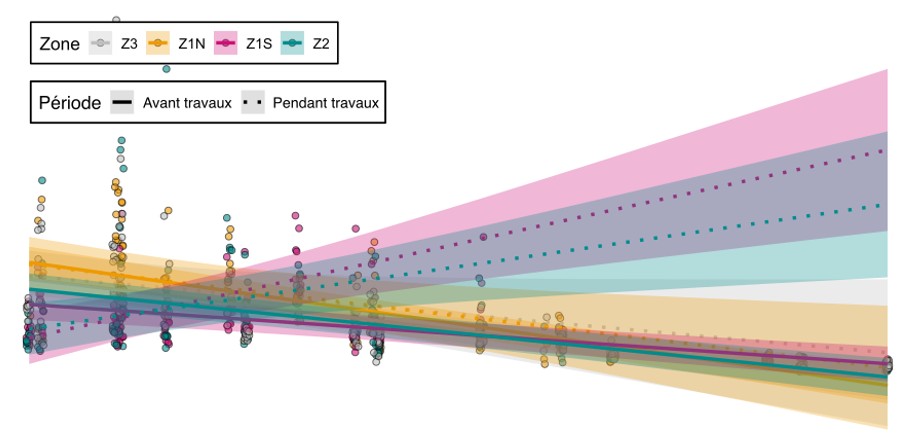
Throughout the recruitment season, newly recruited Diplodus vulgaris are sampled at regular intervals to characterise their developmental trajectory. We examine several complementary phenotypic traits, including:

  • body size and weight
  • body shape and morphometrics
  • pigmentation patterns
  • physiological condition

These measurements allow us to determine whether juveniles developing within different harbour configurations exhibit changes in growth, morphology or developmental condition.
26Z3F058_FULL

3. Is fish metamorphosis affected?

Larval recruitment coincides with a profound developmental transition during which pelagic larvae metamorphose into benthic or demersal coastal juveniles. Because thyroid hormones are major regulators of fish metamorphosis, JUVAPORT investigates both thyroid hormone levels and the expression of genes involved in metamorphic processes. By repeatedly sampling juveniles throughout recruitment, we can reconstruct their developmental and endocrine trajectories and examine whether these trajectories differ before, during and after harbour redevelopment.

4. Can ecological compensation restore nursery functions?

The new harbor infrastructure includes ecological compensation measures based on artificial nursery structures, installed beneath the wharf to provide shelter and feeding opportunities for young fishes. JUVAPORT examines how these structures are used by larval and juvenile fishes and whether they can contribute to restoring part of the nursery function lost through coastal development. Rather than considering artificial habitats solely through juvenile abundance, the project aims to evaluate their ecological value in relation to the development and biological quality of the fishes they host.
2026_06_PV_ArtificialNurseries

A natural before-during-after experiment

One of the major strengths of JUVAPORT is its temporal design to monitor larval and juvenile fish abundances and ecophysiology in natural and artificial nursery habitats within and nearby the harbor. This before–during–after framework provides a rare opportunity to investigate the biological consequences of a major coastal development project under real environmental conditions, and to evaluate the effectiveness of ecological compensation measures.
Ports and other artificial coastal structures occupy an increasing fraction of Mediterranean shorelines. Understanding their effects therefore requires going beyond simple inventories of biodiversity. By linking changes in habitat configuration with recruitment dynamics, individual phenotype, physiology and endocrine development, JUVAPORT aims to provide an integrative assessment of the ecological consequences of harbor redevelopment. The project should ultimately help determine whether ecological engineering measures can effectively mitigate part of the loss of essential fish nursery habitats and inform the design of more biodiversity-compatible coastal infrastructures.

Project team and partners

CEFREM - CNRS, Université de Perpignan Via Domitia

Philippe Lenfant - Coordinator
Gilles Saragoni
Nicolas Lucchini

BIOM - CNRS, Sorbonne Université

Laurence Besseau
Marc Besson
Julie Lherbeil
Laure Fontimpe - PhD student
Justine Benezis - PhD student

Funding

People involved in the EcoEvoDevo team

Related News

Related Publications

Interested in this research?

Our projects regularly involve Master students, PhD candidates and postdoctoral researchers interested in marine Eco-Evo-Devo, ecotoxicology, behaviour and integrative biology.