ACANTHOPLASTICS

How do reef fishes respond to microplastics in their environment?

Acanthoplastics

Project at a glance

2020-ongoing

Monaco (MC)

Banyuls-sur-Mer (FR)

University of Bristol (UK)

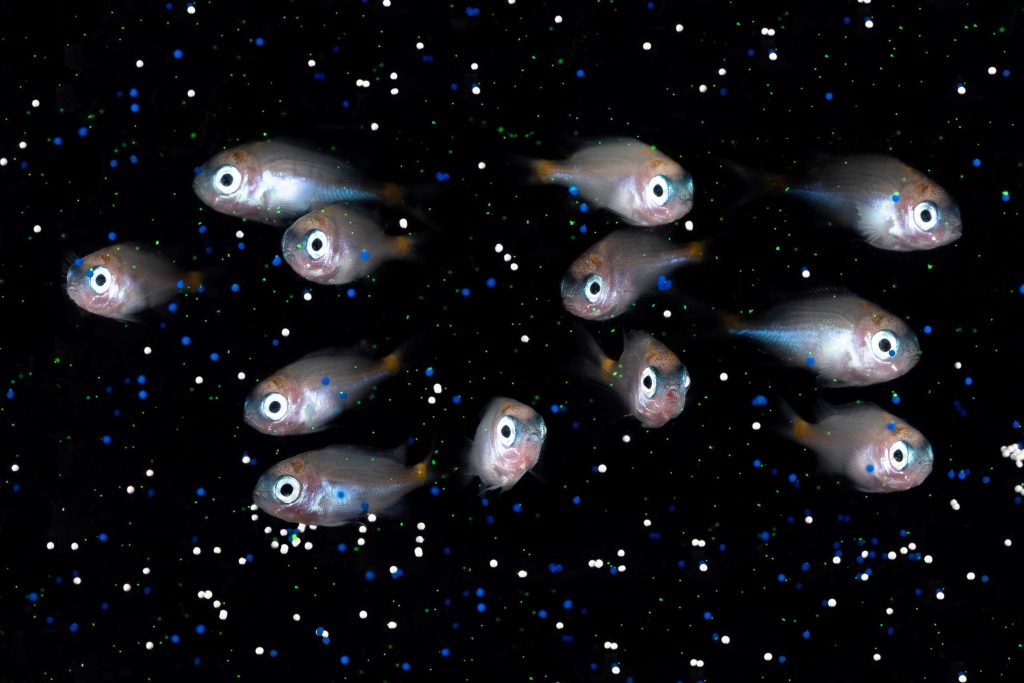
Acanthochromis polyacanthus

Behavioral ecology

Ecotoxicology

Deep learning

Context

Microplastic pollution has become a major research focus in marine ecotoxicology. Numerous studies have examined whether fishes ingest plastic particles and whether chronic exposure affects their physiology, growth, reproduction or behaviour. Nuclear and isotopic techniques have also provided powerful tools for tracing contaminants associated with plastics and understanding their transfer through marine organisms.

Yet an apparently simple ecological question remains surprisingly difficult to answer: what does a fish actually do when it encounters microplastic particles suspended in the water? Before ingestion and any subsequent toxicological effects occur, fishes may detect particles visually or through other sensory pathways and actively approach, avoid or ignore contaminated water. Particle size and feeding motivation may further influence these behavioural decisions.This distinction is important. Experiments with Acanthochromis polyacanthus have shown that ingestion strongly depends on particle size, suggesting that fishes can discriminate against at least some plastic particles. However, conventional exposure experiments cannot determine whether this reflects active avoidance of plastics, rejection during feeding, or other processes occurring after an encounter.

ACANTHOPLASTICS investigates the behavioural decisions fishes make when confronted with microplastic-contaminated water, and uses modern computer-vision and movement-modelling approaches to reconstruct these responses at fine temporal resolution.

Objectives

From microplastic encounters to behavioural decisions

ACANTHOPLASTICS originates from experiments conducted at the IAEA Environment Laboratories in Monaco and now combines these behavioural datasets with new computational approaches developed at EcoEvoDevo. Rather than focusing on the consequences of long-term plastic ingestion, the project asks what happens during the initial encounter between a fish and suspended microplastic particles.
Key questions

1. Do fish approach, avoid or ignore water containing microplastics?

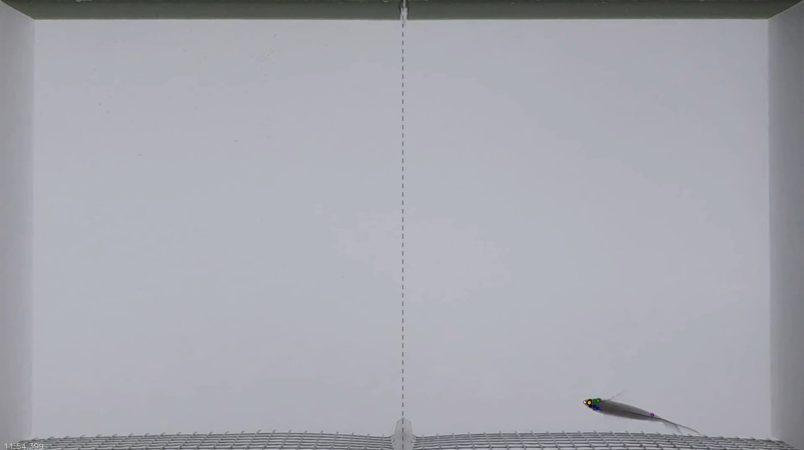
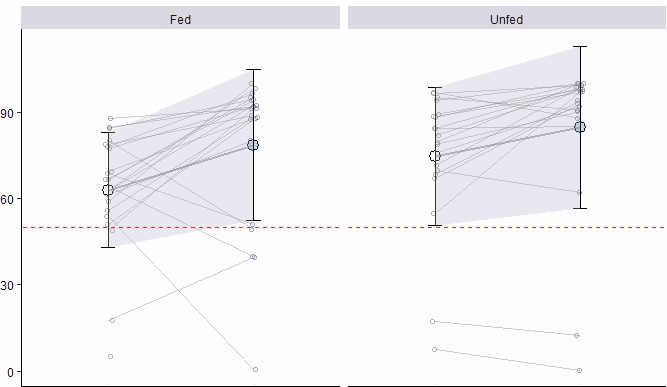
Acanthochromis polyacanthus were tested in a two-channel laminar-flow choice arena in which two parallel water masses could be presented simultaneously. By comparing fish position before and during the introduction of microplastic particles into one water stream, ACANTHOPLASTICS investigates whether fishes modify their spatial behaviour when confronted with plastic-contaminated water.
Acanthoplastics1

2. Does feeding motivation influence behavioural responses to microplastics?

Because suspended particles may overlap in size and appearance with natural prey, behavioural responses could depend on the internal state of the fish. ACANTHOPLASTICS therefore compares individuals differing in recent feeding history to investigate whether feeding motivation modifies attraction, avoidance or exploration of microplastic-containing water.
Acanthoplastics2

3. Can fine-scale movement reveal hidden behavioural states?

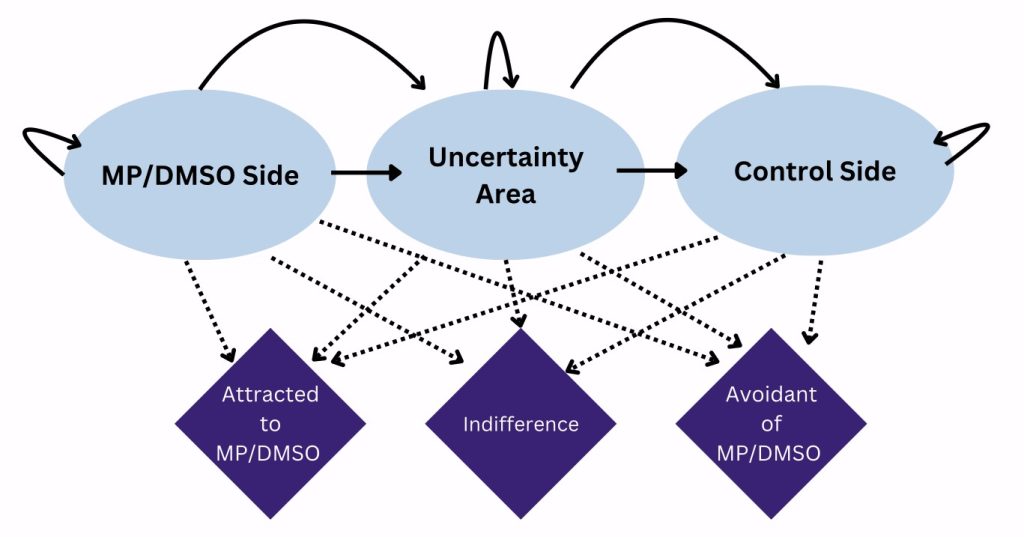
Rather than reducing behaviour to the proportion of time spent on either side of the arena, current work uses deep-learning pose estimation to reconstruct fish trajectories through time. In collaboration with the University of Bristol, state-based movement models are then used to investigate whether trajectories contain recurring behavioural states and transitions consistent with attraction, avoidance or neutral responses to microplastics.

From exposure to perception

The spiny chromis is a robust experimental reef fish that can be maintained and bred under laboratory conditions and has already been used extensively in studies of microplastic ingestion and fish physiology. Previous work has shown that its interaction with plastic particles depends strongly on particle size, making it particularly useful for investigating the behavioural processes that occur before ingestion.
Microplastic ecotoxicology usually begins once organisms have already been exposed. ACANTHOPLASTICS shifts the focus one step earlier by asking whether fishes perceive and behaviourally respond to plastic pollution before ingestion occurs. Combining controlled sensory-choice experiments with automated tracking and state-based movement modelling may help reveal how behavioural decisions influence the actual exposure of marine fishes to microplastics.

Project team and partners

IAEA Marine Environment Laboratories - Monaco

Marc Metian - Coordinator
Peter Swarzenski
François Oberhaënsli
Hugo Jacob - PhD student

University of Bristol

Duncan O'Brien - Postdoc

Funding

IAEA Marine Environment Laboratories - Monaco

Internal research funds
2018-2020

BIOM - CNRS, Sorbonne Université

Internal research funds
Since 2023

People involved in the EcoEvoDevo team

Related News

Related Publications

Interested in this research?

Our projects regularly involve Master students, PhD candidates and postdoctoral researchers interested in marine Eco-Evo-Devo, ecotoxicology, behaviour and integrative biology.